# Tensorflow-Cookbook
**Repository Path**: laver9/Tensorflow-Cookbook
## Basic Information
- **Project Name**: Tensorflow-Cookbook
- **Description**: tensorflow代码片段,包含了对GAN有用的一些通用架构和函数,内容涵盖了谱归一化卷积、部分卷积、pixel shuffle、几种归一化函数、tf-datasetAPI...
- **Primary Language**: Unknown
- **License**: MIT
- **Default Branch**: master
- **Homepage**: None
- **GVP Project**: No
## Statistics
- **Stars**: 0
- **Forks**: 0
- **Created**: 2019-02-28
- **Last Updated**: 2020-12-19
## Categories & Tags
**Categories**: Uncategorized
**Tags**: None
## README
# [Web page](http://bit.ly/jhkim_tf_cookbook)
## Contributions
In now, this repo contains general architectures and functions that are useful for the GAN and classificstion.
I will continue to add useful things to other areas.
Also, your pull requests and issues are always welcome.
And write what you want to implement on the issue. I'll implement it.
# How to use
## Import
* `ops.py`
* **operations**
* from ops import *
* `utils.py`
* **image processing**
* from utils import *
## Network template
```python
def network(x, is_training=True, reuse=False, scope="network"):
with tf.variable_scope(scope, reuse=reuse):
x = conv(...)
...
return logit
```
## Insert data to network using DatasetAPI
```python
Image_Data_Class = ImageData(img_size, img_ch, augment_flag)
trainA_dataset = ['./dataset/cat/trainA/a.jpg',
'./dataset/cat/trainA/b.png',
'./dataset/cat/trainA/c.jpeg',
...]
trainA = tf.data.Dataset.from_tensor_slices(trainA_dataset)
trainA = trainA.map(Image_Data_Class.image_processing, num_parallel_calls=16)
trainA = trainA.shuffle(buffer_size=10000).prefetch(buffer_size=batch_size).batch(batch_size).repeat()
trainA_iterator = trainA.make_one_shot_iterator()
data_A = trainA_iterator.get_next()
logit = network(data_A)
```
* See [this](https://github.com/taki0112/Tensorflow-DatasetAPI) for more information.
## Option
* `padding='SAME'`
* pad = ceil[ (kernel - stride) / 2 ]
* `pad_type`
* 'zero' or 'reflect'
* `sn`
* use [spectral_normalization](https://arxiv.org/pdf/1802.05957.pdf) or not
## Caution
* If you don't want to share variable, **set all scope names differently.**
---
## Weight
```python
weight_init = tf.truncated_normal_initializer(mean=0.0, stddev=0.02)
weight_regularizer = tf.contrib.layers.l2_regularizer(0.0001)
weight_regularizer_fully = tf.contrib.layers.l2_regularizer(0.0001)
```
### Initialization
* `Xavier` : tf.contrib.layers.xavier_initializer()
* `He` : tf.contrib.layers.variance_scaling_initializer()
* `Normal` : tf.random_normal_initializer(mean=0.0, stddev=0.02)
* `Truncated_normal` : tf.truncated_normal_initializer(mean=0.0, stddev=0.02)
* `Orthogonal` : tf.orthogonal_initializer(1.0) / # if relu = sqrt(2), the others = 1.0
### Regularization
* `l2_decay` : tf.contrib.layers.l2_regularizer(0.0001)
* `orthogonal_regularizer` : orthogonal_regularizer(0.0001) & orthogonal_regularizer_fully(0.0001)
## Convolution
### basic conv
```python
x = conv(x, channels=64, kernel=3, stride=2, pad=1, pad_type='reflect', use_bias=True, sn=True, scope='conv')
```
### partial conv (NVIDIA [Partial Convolution](https://github.com/NVIDIA/partialconv))
```python
x = partial_conv(x, channels=64, kernel=3, stride=2, use_bias=True, padding='SAME', sn=True, scope='partial_conv')
```


### dilated conv
```python
x = dilate_conv(x, channels=64, kernel=3, rate=2, use_bias=True, padding='VALID', sn=True, scope='dilate_conv')
```
---
## Deconvolution
### basic deconv
```python
x = deconv(x, channels=64, kernel=3, stride=1, padding='SAME', use_bias=True, sn=True, scope='deconv')
```
---
## Fully-connected
```python
x = fully_conneted(x, units=64, use_bias=True, sn=True, scope='fully_connected')
```
---
## Pixel shuffle
```python
x = conv_pixel_shuffle_down(x, scale_factor=2, use_bias=True, sn=True, scope='pixel_shuffle_down')
x = conv_pixel_shuffle_up(x, scale_factor=2, use_bias=True, sn=True, scope='pixel_shuffle_up')
```
* `down` ===> [height, width] -> [**height // scale_factor, width // scale_factor**]
* `up` ===> [height, width] -> [**height \* scale_factor, width \* scale_factor**]

---
## Block
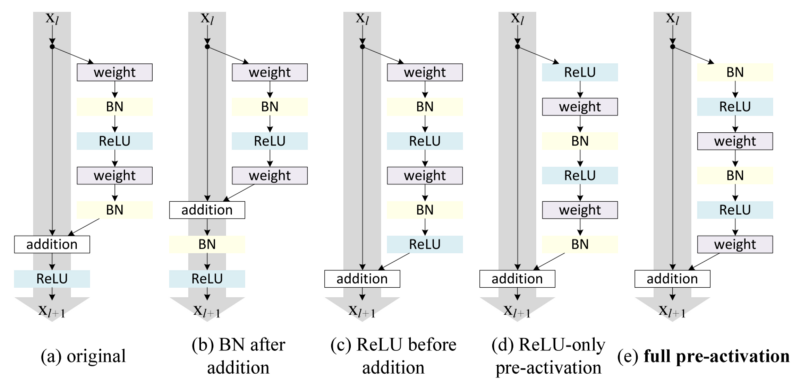
### residual block
```python
x = resblock(x, channels=64, is_training=is_training, use_bias=True, sn=True, scope='residual_block')
x = resblock_down(x, channels=64, is_training=is_training, use_bias=True, sn=True, scope='residual_block_down')
x = resblock_up(x, channels=64, is_training=is_training, use_bias=True, sn=True, scope='residual_block_up')
```
* `down` ===> [height, width] -> [**height // 2, width // 2**]
* `up` ===> [height, width] -> [**height \* 2, width \* 2**]
### dense block
```python
x = denseblock(x, channels=64, n_db=6, is_training=is_training, use_bias=True, sn=True, scope='denseblock')
```
* `n_db` ===> The number of dense-block
### residual-dense block
```python
x = res_denseblock(x, channels=64, n_rdb=20, n_rdb_conv=6, is_training=is_training, use_bias=True, sn=True, scope='res_denseblock')
```
* `n_rdb` ===> The number of RDB
* `n_rdb_conv` ===> per RDB conv layer
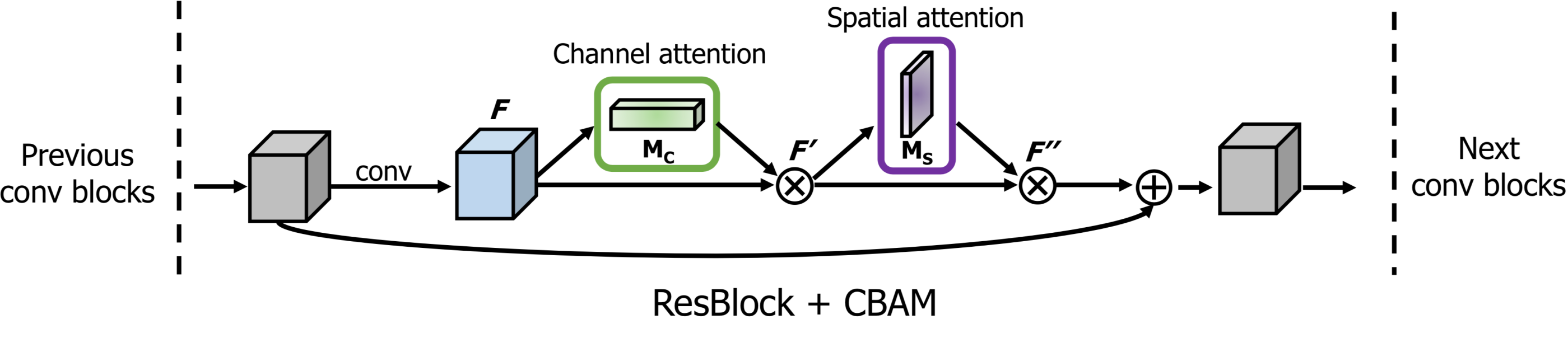
### attention block
```python
x = self_attention(x, channels=64, use_bias=True, sn=True, scope='self_attention')
x = self_attention_with_pooling(x, channels=64, use_bias=True, sn=True, scope='self_attention_version_2')
x = squeeze_excitation(x, channels=64, ratio=16, use_bias=True, sn=True, scope='squeeze_excitation')
x = convolution_block_attention(x, channels=64, ratio=16, use_bias=True, sn=True, scope='convolution_block_attention')
```
---
---
---
## Normalization
```python
x = batch_norm(x, is_training=is_training, scope='batch_norm')
x = layer_norm(x, scope='layer_norm')
x = instance_norm(x, scope='instance_norm')
x = group_norm(x, groups=32, scope='group_norm')
x = pixel_norm(x)
x = batch_instance_norm(x, scope='batch_instance_norm')
x = switch_norm(x, scope='switch_norm')
x = condition_batch_norm(x, z, is_training=is_training, scope='condition_batch_norm'):
x = adaptive_instance_norm(x, gamma, beta)
```
* See [this](https://github.com/taki0112/BigGAN-Tensorflow) for how to use `condition_batch_norm`
* See [this](https://github.com/taki0112/MUNIT-Tensorflow) for how to use `adaptive_instance_norm`
---
## Activation
```python
x = relu(x)
x = lrelu(x, alpha=0.2)
x = tanh(x)
x = sigmoid(x)
x = swish(x)
```
---
## Pooling & Resize
```python
x = up_sample(x, scale_factor=2)
x = max_pooling(x, pool_size=2)
x = avg_pooling(x, pool_size=2)
x = global_max_pooling(x)
x = global_avg_pooling(x)
x = flatten(x)
x = hw_flatten(x)
```
---
## Loss
### classification loss
```python
loss, accuracy = classification_loss(logit, label)
```
### pixel loss
```python
loss = L1_loss(x, y)
loss = L2_loss(x, y)
loss = huber_loss(x, y)
loss = histogram_loss(x, y)
```
* `histogram_loss` means the difference in the color distribution of the image pixel values.
### gan loss
```python
d_loss = discriminator_loss(Ra=True, loss_func='wgan-gp', real=real_logit, fake=fake_logit)
g_loss = generator_loss(Ra=True, loss_func='wgan-gp', real=real_logit, fake=fake_logit)
```
* `Ra`
* use [relativistic gan](https://arxiv.org/pdf/1807.00734.pdf) or not
* `loss_func`
* gan
* lsgan
* hinge
* wgan
* wgan-gp
* dragan
* See [this](https://github.com/taki0112/BigGAN-Tensorflow/blob/master/BigGAN_512.py#L180) for how to use `gradient_penalty`
### [vdb loss](https://arxiv.org/abs/1810.00821)
```python
d_bottleneck_loss = vdb_loss(real_mu, real_logvar, i_c) + vdb_loss(fake_mu, fake_logvar, i_c)
```
### kl-divergence (z ~ N(0, 1))
```python
loss = kl_loss(mean, logvar)
```
---
## Author
Junho Kim